
Advanced Shipping and Receiving (ASR) in SAP EWM and TM

Advanced Shipping and Receiving (ASR) is the modern integration concept introduced in S/4HANA 2020 FPS01 that fundamentally changes how SAP EWM and SAP TM talk to each other. On real implementations, ASR removes the old Transportation Unit (TU) document, makes the Freight Order the single source of truth, and cuts out fragile SOAP/XML message flows. Automotive, retail, CPG, and 3PL customers use ASR to run basic EWM–TM scenarios under the standard SAP Enterprise Management license without paying for advanced TM licensing.
In this section of our SAP EWM L3 training, you will learn ASR the way architects actually design it — not the way documentation describes it. We cover the BOPF framework behind ASR, actions, determinations, and validations, and how BGRFC trigger IDs help you debug integration issues in production. You will also understand when ASR is the right fit versus when legacy LDAP integration still wins, especially for cross-docking and complex transportation planning. This is the clarity most consultants miss before go-live.
Key learnings:
- ASR as integration concept, not a module
- Freight Order as single primary document
- BOPF framework and BGRFC trigger IDs
- Warehouse-driven vs transportation-driven scenarios
- When ASR loses to legacy LDEP integration
Warehouse-Driven Outbound ASR Scenario
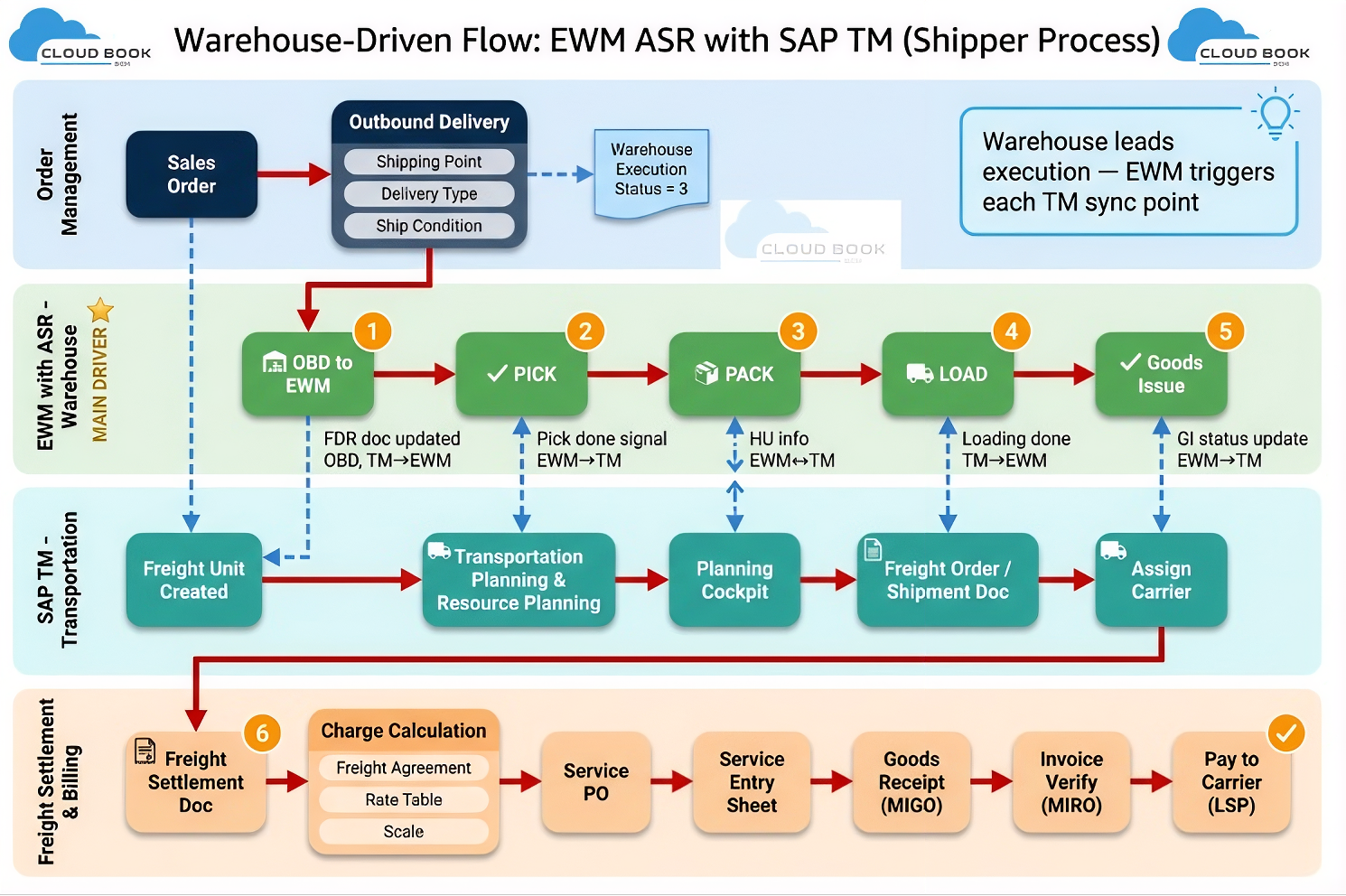
The warehouse-driven outbound scenario is where most EWM-led customers start their ASR journey. Picking, packing, and staging happen inside SAP EWM while the Freight Order stays blocked in SAP TM — loading only begins once the warehouse sends the shipping readiness signal. This model suits distribution centres, e-commerce fulfilment hubs, pharma warehouses, and any business where inventory readiness controls dispatch. It is the cleanest way to keep warehouse KPIs and transportation KPIs aligned without custom development.
Key learnings:
- End-to-end happy path: delivery → freight unit → goods issue
- DSH status flip 1 → 9
- ASR activation at shipping point
- Door determination and control key 053
- Weight/volume and STO limitations
ASR Transportation-Driven Outbound
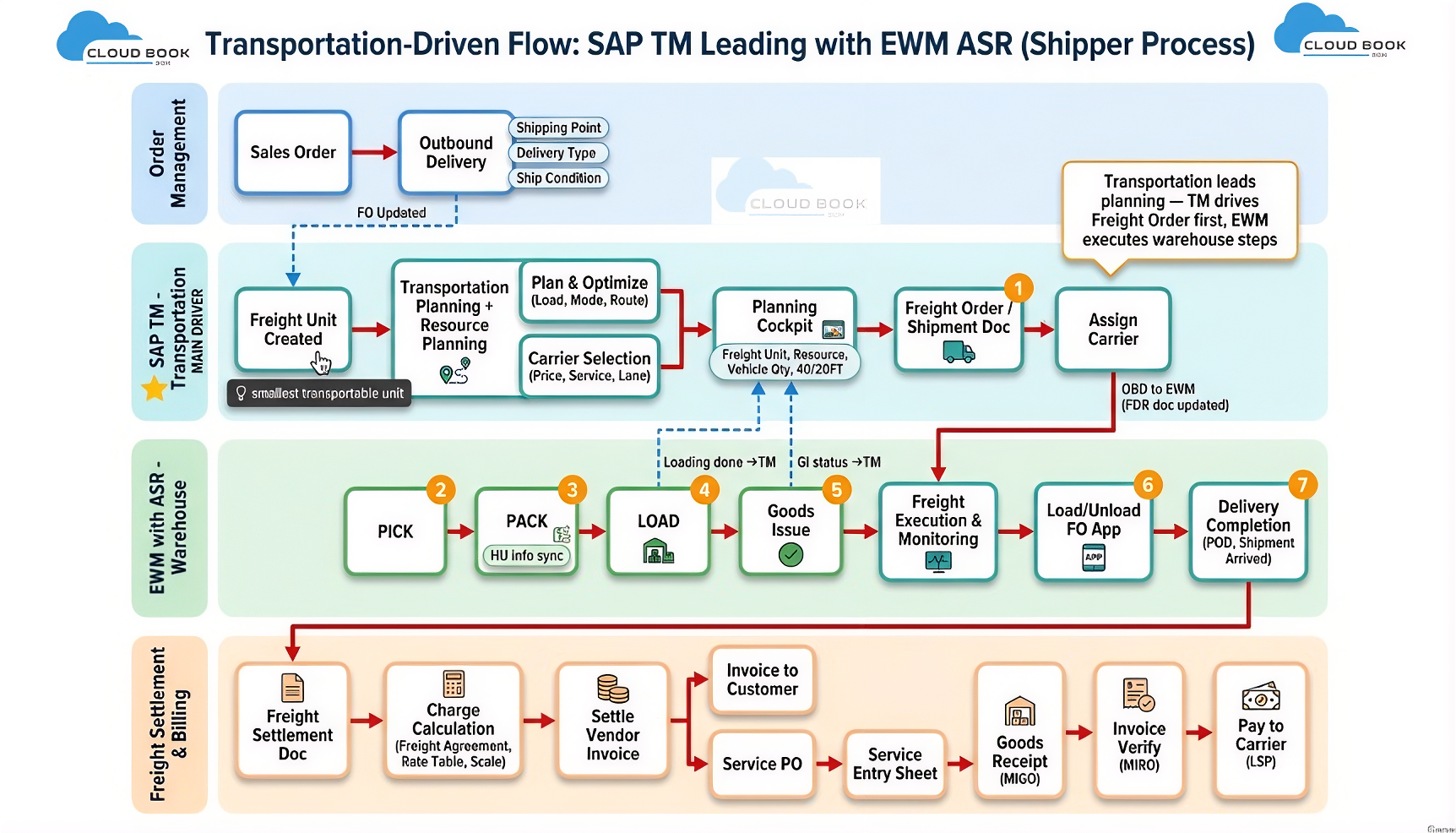
Not every warehouse is EWM-led. Many clients — especially in automotive inbound, contract logistics, and fleet-heavy industries — run transportation-driven flows where SAP TM initiates the process and EWM reacts. In the inbound ASR cycle, the ERP inbound delivery creates a freight unit in TM, the inbound delivery stays blocked in EWM, and the “Ready for Warehousing” action becomes the single most important handover between the TM planner and the warehouse team. Getting this handshake wrong delays goods receipt across the entire network.
Key Learnings:
- Inbound flow: ERP delivery → freight unit → EWM unblock
- Quantity differences and carrier payment logic
- Transportation-driven outbound and ODO blocking
- Document type, item type, and date profile mapping
- BAdI for shared document types
- Yard logistics not supported
ASR Splits, Customer Returns, and Real-World Limitations
Every ASR implementation eventually hits an exception — the truck fills up before all HUs are loaded, a customer returns damaged stock, or a client demands cross-delivery HUs. This is where senior EWM and TM consultants earn their fees. ASR outbound splits, immediate loading at HU level, and ASR-enabled customer returns are the scenarios that separate a working go-live from a painful hyper care. Retail returns, DTC e-commerce, and high-volume distribution networks depend on these variations running clean from day one.
Key Learnings:
- ASR outbound split via technical process code 07
- Immediate loading at HU level
- ASR-enabled customer returns without standard BC set
- Function module for ERP → EWM returns
- Unsupported: cross-delivery HUs, two-step picking, TCD, GTS at ODO
Real Business Scenarios: When to Choose ASR or LDAP
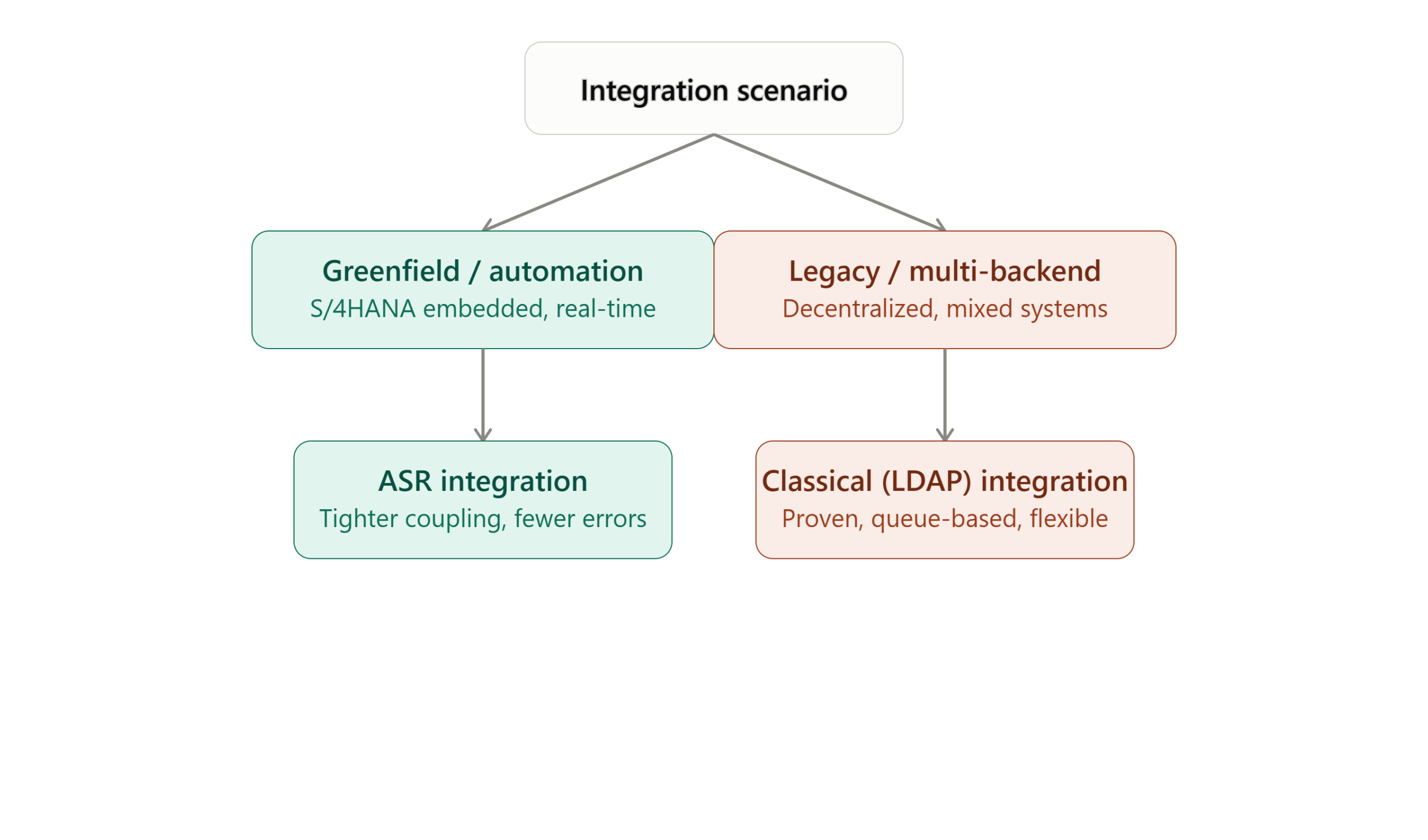
As a principal EWM consultant, I don’t pick ASR or classical LDAP-based integration on preference — it comes down to landscape maturity, real-time need, and how many backend systems TM/EWM must talk to.
| Business scenario | Recommended approach | Consultant rationale |
|---|---|---|
| Legacy landscape (ECC or older EWM release, decentralized) | Classical (LDAP-based) | ASR needs S/4HANA embedded; classical queue integration is proven and stable here |
| Greenfield S/4HANA implementation | ASR | Real-time sync, fewer number-range conflicts, avoids errors like SAPSLDAPI destination issues |
| Warehouse automation project (MFS, ASRS, conveyors) | ASR | Automation needs near real-time TU/HU status; queue latency creates bottlenecks on the shop floor |
| Yard management, high TU volume | ASR preferred, hybrid if needed | Real-time yard task visibility to TM; fall back to classical if part of the yard still runs on ECC |
| Multiple TM systems / one EWM (multi-backend) | Classical (LDAP-based) | ASR is currently built for 1:1 embedded scenarios; classical handles multi-system distribution better |
The rule of thumb: greenfield and automation-heavy projects lean ASR for speed and reliability; legacy, hybrid, or multi-backend landscapes lean on classical LDAP integration until the whole landscape is ready to move to embedded S/4HANA.
Q1. What is Advanced Shipping and Receiving (ASR) in SAP EWM? ASR is an integration concept between SAP EWM and SAP TM introduced in S/4HANA 2020 FPS01. It removes the separate Transportation Unit (TU) document, makes the Freight Order the single primary document, and simplifies communication using direct integration instead of SOAP/XML messages.
Q2. Is ASR a new SAP module? No. ASR is not a standalone module. It is an integration concept that connects SAP EWM and SAP TM using the BOPF framework, BGRFC calls, and direct method-based communication.
Q3. Does ASR require an advanced SAP TM license? No. ASR allows customers to use basic SAP EWM and TM functionality under the standard SAP Enterprise Management (EM) license — one of the biggest reasons customers adopt it.
Q4. What is the difference between warehouse-driven and transportation-driven ASR? Warehouse-driven ASR is initiated from EWM and focuses on inventory readiness. Transportation-driven ASR is initiated from TM and focuses on fleet execution, using the “Ready for Warehousing” step to unblock EWM activities.
Q5. What is the “shipping readiness” signal in ASR? It is a critical signal sent from EWM to TM (status change from 1 to 9) that releases the Freight Order for execution — allowing loading and departure to proceed.
Q6. What are the main limitations of SAP EWM ASR? ASR currently does not support yard logistics, cross-delivery HUs, two-step picking, TCD, GTS at ODO level, and STO within a single freight order. Weight and volume updates flow only through HU-linked changes.
Q7. How are ASR issues troubleshot in production? Troubleshooting is done by tracing BGRFC trigger IDs to identify the exact action name and implementation class within the BOPF framework, along with SLG1 logs and system telegram checks.
Q8. How is a Bill of Lading printed in an ASR scenario? In ASR, output documents like Bills of Lading use TM-specific PPF (Post Processing Framework) configurations, changing the application from the standard EWM application to SCMTMS.
Q9. Should I choose ASR or a full SAP TM implementation? ASR fits customers who need basic EWM–TM integration without freight settlement, carrier tendering, or multi-modal planning. Full SAP TM is required for complex transportation, freight cost management, and long-term logistics roadmaps.
Q10. Who should take the SAP EWM ASR L3 Super Advanced training? SAP EWM consultants, SAP TM consultants, solution architects, technical consultants, warehouse automation specialists, and corporate training decision makers working on S/4HANA logistics implementations.
Conclusion
Advanced Shipping and Receiving (ASR) simplifies SAP EWM and SAP TM integration, improving warehouse execution, transportation planning, and overall supply chain efficiency. Mastering ASR is essential for consultants working on modern SAP S/4HANA EWM implementations.
To build expertise in advanced SAP EWM topics, SCM-Cloudbook offers practical training on MFS, ASR, Cartonization Planning, Dock Appointment Scheduling, SAP EWM ABAP, MES Integration, ASRS, and Warehouse Automation, with a strong focus on real-world implementation scenarios and hands-on learning.
Connect for any enquiry on TM/EWM expertise:
SAP EWM L3 – Consulting| watsapp: wa.link/04d8tw