
Common Errors with Movement Types and How to Fix Them

Movement types in SAP Material Management are three-digit small codes, but they can create a significant mess if not understood. Users of SAP experience many posting failures, stock mismatches, or accounting problems, and often do not realize that these issues are caused by incorrect use of movement types. These are the most prevalent errors of this type of SAP movement in live environments.
This blog is meant to transcend definitions. It describes the practical use of SAP MM movement types, the risks associated with such use, and how to eliminate and avoid SAP inventory movement errors through certainty.
Understanding Movement Types in SAP MM
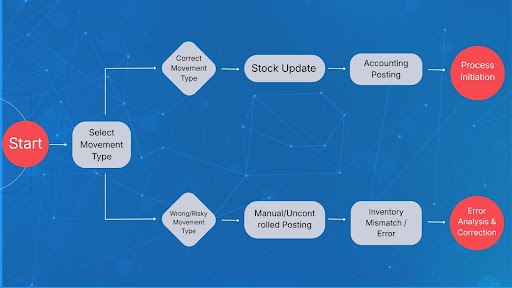
The MOVE types are the backbone of inventory transactions in SAP MM. Users frequently searched for movement types to understand why similar-looking transactions do not behave as expected in the system. The solution lies in how movement types manage stock updates, valuation, and accounting rationale in the back office.
What Are the Movement Types in SAP MM?
The movement type in SAP MM is a three-digit code that indicates the type of material movement. Depending on receipt, issue, transfer, and adjustment of goods, the chosen movement type in SAP determines how stock quantities and values are updated.
Every type of movement is closely interconnected with business logic. Even a single error in the selection process can lead to incorrect stock or unsuccessful postings, and movement types are a crucial concept in daily SAP work.
Significance of Movement Types in SAP MM
The significance of movement types extends beyond inventory changes. They set accounting postings, stock status change (unrestricted, quality, blocked) and audit traceability. The consequences of misinterpreting or misusing movement types are frequent. When movement types are not properly understood and used, there is a high likelihood of recurring SAP inventory movement errors that plague the logistics and finance departments.
Commonly Used SAP MM Movement Types and Their Purpose
Most SAP errors are not due to a lack of access, but rather to the user not being clear about when to use a particular movement type. The purpose of the common movements is to identify and prevent incorrect postings.
Movement Types 501 and 502 in SAP
There are two movement types: 501 is applied when the receipt of goods is made without any purchase order, and 502 is applied to reverse these entries. These are very strong, though hazardous, forms of movement when used casually.
Posting stock without a required procurement reference, incorrect reversals, and unforeseen accounting entries are common problems. Consequently, 501 and 502 are often recorded in the course of auditing or reconciling SAP movements.
Movement Type 309 – When and Why It Is Used
Movement type 309 is employed to redirect the stock of one material number to another without the physical transfer. It is normally applied in reclassification or correction cases.
There are errors where the shortcut of using 309 instead of a proper issue and receipt process is applied. This usually causes valuation incompatibilities and stock discrepancies in the long run, which are difficult to detect.
Risky Movement Types That Commonly Cause Errors
Certain types of movement are considered risky because they involve direct/manual postings with little system validation. Such movements frequently cause repetitive SAP issues in production systems.
What Are the Risky Movement Types in SAP?
The type of movement considered risky typically permits postings without purchase orders, production orders, or strong controls. Some of them are adjustment postings, scrap movements and GR without reference.
Inappropriate use of these movement types often leads to SAP movement-type errors that affect inventory accuracy and financial reporting.
Risky Material Movement Types in SAP MM
Types of material movement that directly affect valuation or stock status can cause long-run discrepancies if not managed. Unless this is properly authorised and processes are disciplined, such movements commonly lead to errors in SAP inventory movements, which are only discovered many years later during audits.
Common SAP Movement Type Errors in Real Scenarios
When working with real SAP systems, movement-type problems are not often manifested as error messages. They instead present themselves as baffling posting issues or erroneous stock action that irritates end users.
What Are Common Errors Related to Movement Types in SAP MM?
A workable summary of common SAP issue types related to movement, their causes, and potential solutions has been explained below in the table:
| Error / Issue | Movement Type Involved | Main Cause | How to Fix It |
| Posting not allowed for movement type | 201, 261, 501 | Movement type restricted for plant or process | Review movement type configuration and authorization controls |
| Plant not maintained in inventory management | Any GR/GI movement | Inventory management is not activated for the plant | Activate inventory management for the plant and storage location |
| Account determination failed | 501, 309, 551 | Missing or incorrect valuation class | Verify valuation class and GL account assignment |
| Stock type mismatch | 101, 103, 311 | Incompatible stock type selected | Use the correct stock type or compatible movement type |
| Quantity or value inconsistency | 309, 561 | Material master or valuation mismatch | Check the material master and valuation settings |
| Reversal not possible | 502, 102 | Original document already adjusted | Trace the original posting and apply the correct reversal process |
Plant Not Maintained in Inventory Management
This is among the most common SAP MM mistakes and often puzzles users. It occurs when inventory management is not triggered at a plant or other store, despite selecting the appropriate movement type.
The type of movement does not cause the error; rather, the movement is not properly configured, which is a classic example of how SAP inventory movement errors usually occur off-screen.
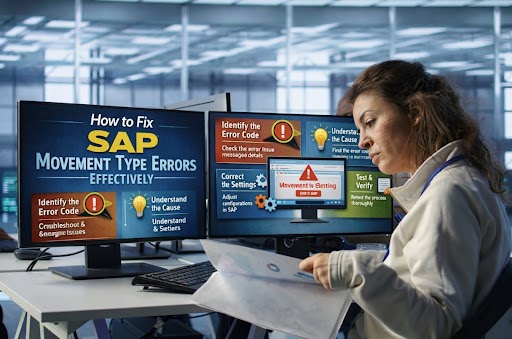
How to Fix SAP Movement Type Errors Effectively
The vast majority of SAP users do not look for theory; they look for fixes. The upside is that most movement-type problems are configuration or process-based and can be addressed systematically.
How Do You Change a Movement Type in SAP?
Types of movement can be configured with normal SAP configuration transactions. Nonetheless, modifications must be implemented after due validation.
Before modifying a movement type:
- Confirm the business requirement
- Review posting rules and valuation impact
- Test thoroughly in a non-production system
Unplanned changes usually introduce SAP movement type errors rather than resolving existing ones.
Fixing Plant and Inventory Configuration Errors
To fix plant-related issues:
- Ensure inventory management is activated
- Verify storage location and valuation settings
- Check the material master completeness
These steps resolve a large percentage of SAP MM posting issues.
Stock Posting Types and Their Movement Types in SAP MM
Types of stock posting establish the location of stock, whereas types of stock movement establish the movement of a stock. Misunderstanding between the two terms is a common cause of SAP mistakes.
Different Stock Posting Types in SAP MM
SAP has several types of stock: unrestricted-use, quality inspection, and blocked stock. The types are limited to specific SAP MM movements. Using the wrong combination leads to posting failures or incorrect inventory reporting.
Common Posting Errors Linked to Stock and Movement Types
Mistakes are usually made when users select an inappropriate stock type for a specific movement. This explains the importance of understanding the correlation between stock status and logical movement.
Best Practices to Avoid SAP Inventory Movement Errors
Preventing errors is more efficient than fixing them later. So, organizations must avoid errors and take care of the following points:
- Train users on the correct movement type usage
- Restrict risky movement types
- Standardize inventory processes
- Periodically audit movement type usage
The practices significantly reduce errors in SAP inventory movement and enhance system stability.
Final Thought- Fixing SAP Movement Type Errors the Right Way
Movement types are not merely technical; they are business-critical controls in SAP MM. The majority of movement-type errors in SAP arise from misconceptions, unsafe application, or poor configuration, rather than from system constraints.
With this understanding of movement types in SAP, organizations can identify risky situations and apply best practices, achieving accurate inventory, clean accounting, and smooth SAP operations.
At SCM-Cloudbook , we focus on hands-on SAP training, real-world project scenarios, and error-based learning, so you not only learn SAP concepts but also how to solve real SAP problems.
Get acquainted with the SAP MM training and consultation programs offered by Explore SCM-Cloudbook today and gain confidence in them.
Contact SCM-Cloudbook today to choose the SAP certification that matches your career vision.
Connect with us directly: Registration Link
WhatsApp: (wa.link/04d8tw or ✆ +91-9289246569).
SCM-CLOUDBOOK
FAQ’s
1. What are movement types in SAP MM, and why are they important?
SAP MM movement types are three-digit codes that govern inventory and accounting processes, and one of the major reasons SAP inventories are prone to movement errors is the improper selection of movement types.
2. What are the most common SAP movement type errors faced by users?
Some of the most prevalent errors in the movement type common in SAP are posting not allowed, mismatch in stock types, failure to determine account, incorrect quantity, and failure to maintain the plant in the inventory management.
3. Why does the error “Plant not maintained in inventory management” occur in SAP MM?
This is a mistake that arises when inventory management is not turned on of a plant or a storage location, although a valid movement type in SAP occurs.
4. Which SAP MM movement types are considered risky and why?
The types of SAP MM movements that can be classified as risky include those that permit direct or manual postings with no reference documents, thereby increasing the likelihood of inventory and valuation inconsistencies.
5. How can SAP movement type errors be prevented in daily operations?
Errors in SAP movement types can be eliminated by using standard movement types, limiting risky postings, confirming configuration, and training users on the proper use of SAP MM movement types.
