
SAP S/4 HANA TM : Carrier invoice verification and self-billing (ERS)
Carrier invoice verification and self-billing (ERS) are where transportation execution meets accounts payable. Here is the end-to-end flow:
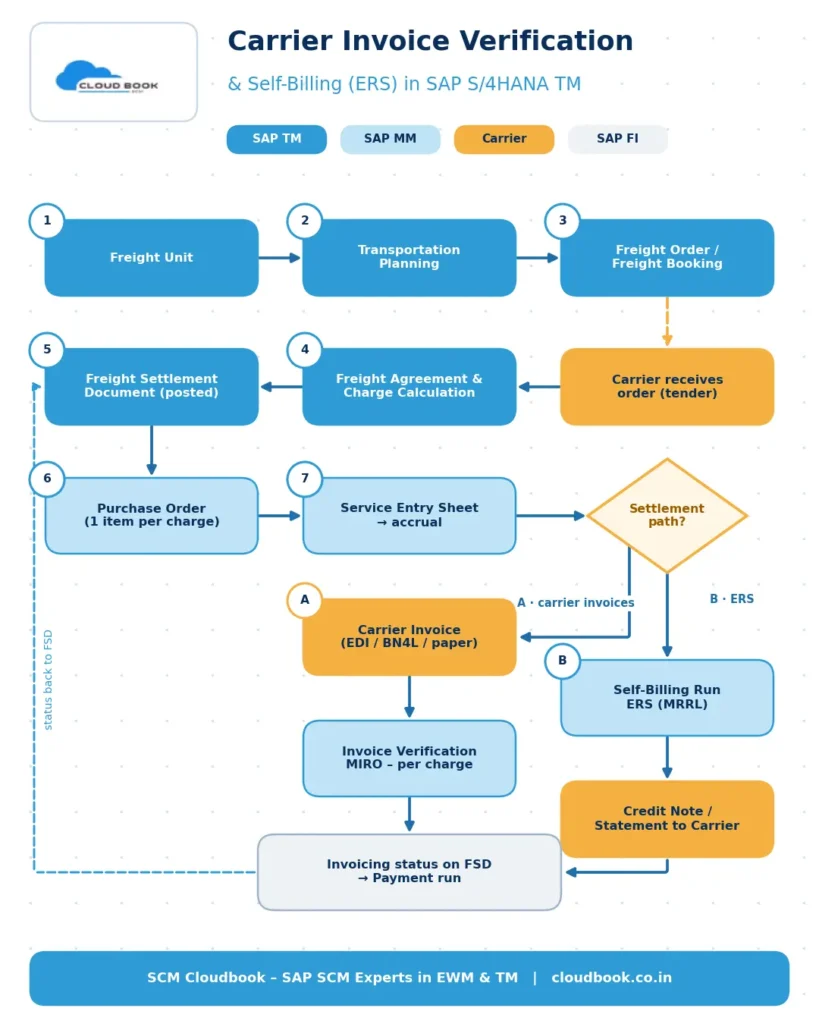
🔹 Planning and execution (SAP TM)
1️⃣ Freight Unit: created from the delivery or order
2️⃣ Transportation Planning: units are consolidated and a carrier is selected
3️⃣ Freight Order / Freight Booking: tendered and sent to the carrier
4️⃣ Freight Agreement & Charges: the agreement is determined and charges are calculated
5️⃣ Freight Settlement Document (FSD): with Lean Services, created and posted in one step
🔹 Procurement and accrual (SAP MM)
6️⃣ Purchase Order: a service PO with one item per charge
7️⃣ Service Entry Sheet: approved automatically, which posts the freight accrual
🔹 Then one of two settlement paths:
🅰️ Carrier invoice
The carrier sends an invoice by EDI, SAP Business Network or paper. Invoice verification (MIRO) matches each charge against the PO and SES. Differences go into a structured dispute instead of an email chain.
🅱️ Self-billing (ERS)
No carrier invoice is needed. The ERS run (MRRL) settles directly from the PO and SES, and a credit note / settlement statement goes to the carrier. This works best when agreements are clean and charges are predictable.
✅ Either way, the invoicing status is updated back on the FSD, and FI runs the payment.
Self-billing (ERS): the shipper settles based on its own calculated charges using MRRL. The carrier can view the settlement and dispute it through collaboration. This works best when agreements are clean and charges are predictable.
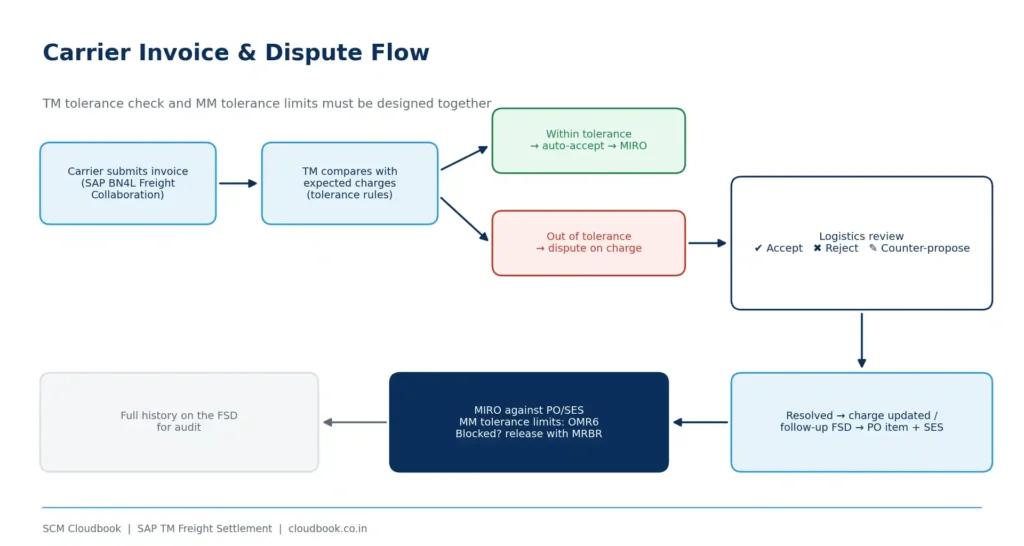
Carrier invoice submission: the carrier submits an invoice against freight documents, and TM compares it with the expected charges using tolerance rules. Differences within tolerance can be auto-accepted. Anything beyond tolerance goes to a dispute that logistics reviews, where they can accept, reject or counter-propose.
Channel: SAP Business Network for Logistics (Freight Collaboration) is the strategic channel for carrier invoicing and disputes. Many projects still run older collaboration portal setups, but that is not the future direction.
MM-side safety net: even after TM has accepted an invoice, MIRO still applies the MM tolerance limits configured in OMR6. Blocked invoices are released with MRBR. Design the TM tolerances and MM tolerances together. Otherwise you get invoices that TM accepted and MM blocked, and nobody knows why.
