
SAP EWM, TM & MM Corporate Training : How We Help Companies Upskill Teams
SAP EWM, TM & MM Corporate Training: How We Help Companies Upskill Teams
When a company implements or upgrades SAP EWM, TM or MM, the technology is only half the challenge. The other half is making sure the team running it actually understands the system deeply enough to use it well from day one — not just click through a few transactions, but handle exceptions, understand the business logic behind configuration decisions, and know when something needs escalation versus when it’s routine.
That gap is where generic corporate SAP training usually falls short. One-size-fits-all sessions cover the basics and stop there, leaving teams to learn the hard parts on the job, during go-live, under pressure. Here’s how SCMCloudbook approaches corporate SAP EWM and TM training differently — and what the typical journey toward EWM adoption actually looks like for a company encountering it for the first time.
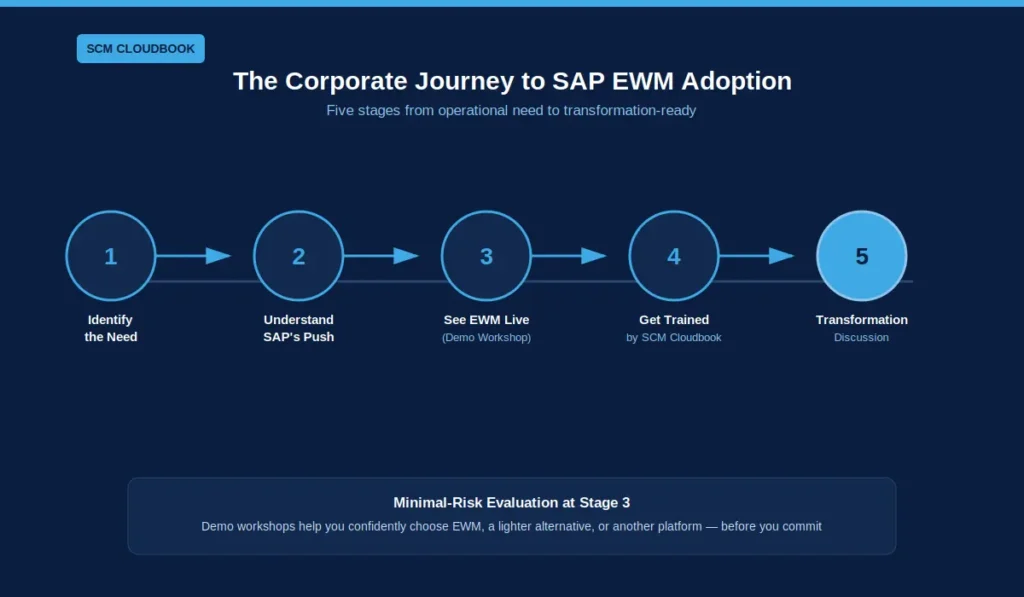
The Corporate Journey to SAP EWM Adoption: A Five-Stage Lifecycle
Most companies don’t wake up one day and decide to implement SAP EWM. It’s usually a gradual path, and understanding where you are on it helps clarify what kind of support actually helps next.
1. Identify the Need
The starting point is almost always an operational pain point, not a product decision — warehouse visibility gaps, manual processes that don’t scale, inefficient transportation planning, or a broader S/4HANA migration surfacing the question of what to do with existing warehouse management. At this stage, the need is clear, but the right solution usually isn’t yet.
2. Understand Why There’s a Push from SAP
As companies explore options, they run into SAP’s own product direction — the shift toward S/4HANA, the positioning of Extended Warehouse Management as the strategic path forward, and increasingly, SAP’s push toward AI-assisted and autonomous supply chain capabilities. This stage is often where confusion sets in: teams need to understand why SAP is steering the market this way, and whether that direction actually fits their own operations.
3. Build Early Understanding of How the Process Actually Looks in EWM
This is the stage where decisions are made or delayed based on incomplete information — and where a live, hands-on look at the system matters most. Seeing real EWM business scenarios in action, rather than reading about them, is what turns an abstract product decision into a concrete, evaluable one. Our Business Process Flow Demo Workshops exist specifically for this stage — more on that below.
4. Get Trained in EWM from SCM Cloudbook
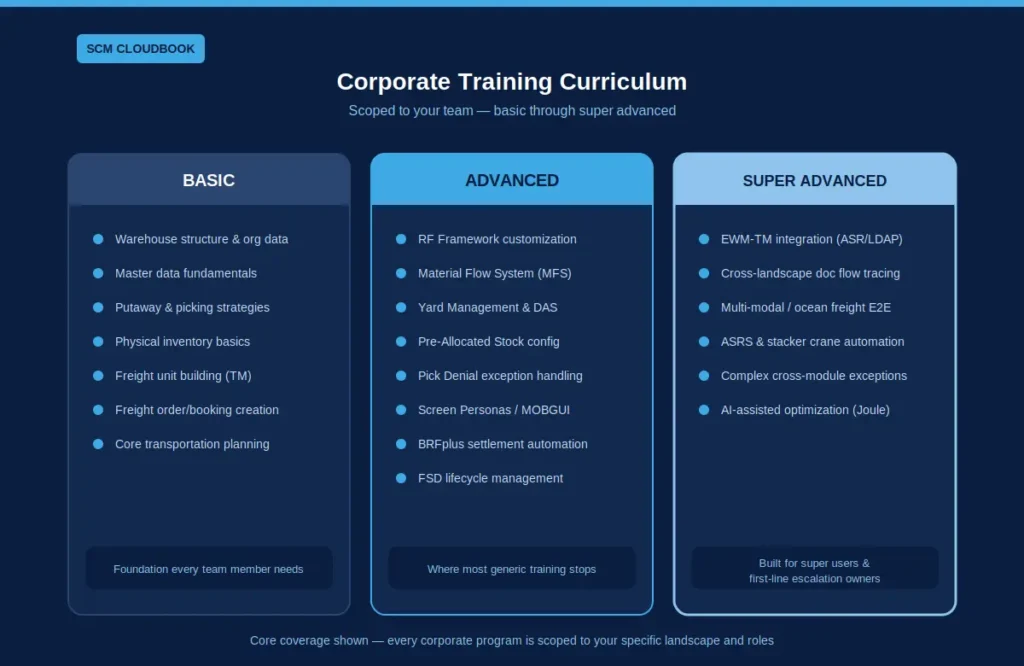
Once a company has enough clarity to move forward, structured training — not ad hoc exploration — is what builds a team capable of actually running the system. This is where our basic-to-super-advanced curriculum comes in, scoped to the roles and landscape involved, covered in detail further down this page.
5. Identify the Gap and Move Into Business Transformation Discussion
With a trained team, companies are finally equipped to have an honest, informed conversation about their own transformation — where EWM fits, where it doesn’t, what gaps remain between current operations and target state, and how to sequence the rollout. Training at this stage isn’t just skill-building; it’s what makes a real transformation discussion possible in the first place, rather than one driven by vendor pitches alone.
Business Process Demo Workshops: Understand EWM Before You Implement It
Complex EWM scenarios — wave management, yard operations, automated storage and retrieval — are difficult to evaluate from a slide deck or a sales pitch alone. This is exactly the gap Stage 3 above describes, and it’s why we offer SAP Business Process Flow Demo Workshops — structured, hands-on sessions where your team walks through real EWM business scenarios in a live system before implementation decisions are locked in.
The advantage this gives companies new to EWM is real and practical: it lets you evaluate fit with minimal risk, before committing budget or timeline. A demo workshop can help a company confidently decide to move forward with EWM, recognize that a lighter-weight approach fits better, or even determine that a different SAP product — or a non-SAP option like Oracle Transportation Management (OTM) on the transportation side — is the more appropriate fit for their specific operation. Getting that clarity before implementation, rather than discovering it mid-project, is where the real value sits.
Beyond Training: End-to-End Demos, Migration Support and Post-Training Assistance
Upskilling your team’s technical capability in EWM, TM and MM is necessary, but it is not, on its own, sufficient. An organization moving toward these modules on S/4HANA needs several things happening in parallel: a trained workforce, a validated view of how their own business processes will actually run in the target system, a working understanding of the standard and custom tools available for getting existing data into the new system, and support that doesn’t simply end when the last training session does. Our engagement model is built around all four.
End-to-End Process Flow Demos
Beyond individual skill-building, we configure and walk through a client’s actual business processes end-to-end within a representative EWM, TM or MM environment — inbound through putaway and stock removal, procure-to-pay through inventory management, or order fulfillment through freight settlement — so stakeholders see a configured outcome, not a generic textbook flow. This is deliberately positioned as a close look and feel of the system: it lets business and IT stakeholders jointly validate that a proposed configuration genuinely supports their operational requirements before it’s committed to a production timeline, and it’s available as a standalone Business Process Flow Demo Workshop independent of a full training engagement.
Migration Support: SAP Standard Tools and Custom Approaches
For organizations moving from classic Warehouse Management (LE-WM) or legacy MM configurations into S/4HANA, a significant part of project risk sits in the data and cutover approach, not just the target configuration. We help client teams build working knowledge of SAP’s standard migration tooling — including the S/4HANA Migration Cockpit and its associated migration object modeler, the structured migration objects used for warehouse product and storage bin data, and the dedicated reports built specifically for LE-WM to embedded EWM transfers.
Where standard tools don’t fully cover a client’s specific data landscape or legacy system quirks — which is common in real migrations — we also guide teams through custom migration approaches: staging-table-based transfers, file-upload methods, and mapping strategies tailored to non-standard source data. The intent isn’t to replace a dedicated migration project team, but to ensure your internal resources understand what these tools do, where they fit in a cutover plan, and when a custom approach is genuinely necessary versus over-engineering a standard problem.
Post-Training Support
Training doesn’t end when the sessions do. Teams inevitably run into real configuration questions once they’re back in their own environment applying what they’ve learned — a scenario that didn’t come up in class, an exception code behaving unexpectedly, a question about whether a customization is standard practice. We provide structured post-training support so your team has somewhere to take those questions, rather than being left to figure it out alone during an actual project.
Together, these elements mean SCM Cloudbook’s role with a corporate client extends well beyond the classroom: we help you validate the target state, understand the path to get there, and stay supported once you’re executing on it.
Course Content: What We Actually Cover
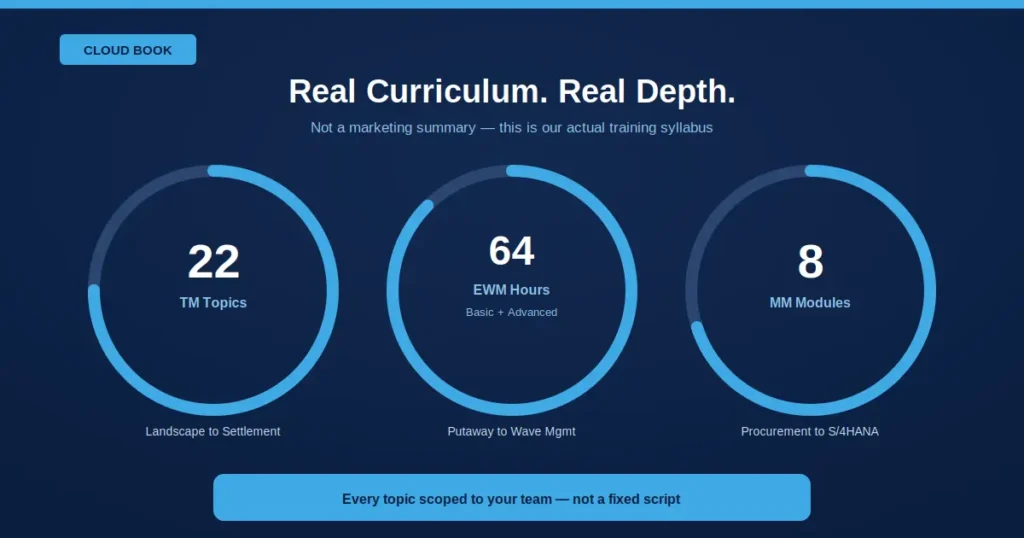
The topic lists below are drawn directly from our current EWM, TM and MM training syllabi — this is the real curriculum, not a marketing summary. Every corporate engagement is scoped from this coverage based on what your team’s roles and landscape actually require.
SAP EWM (S/4HANA Embedded) — Basic Course (40 hrs)
- Introduction to EWM — system overview, deployment options, Embedded vs. Decentralized EWM, major functions
- ERP-EWM Integration — data distribution model, delivery document integration, warehouse mapping, availability groups
- Organizational Elements and Master Data — storage types, storage sections and bins, activity areas, work centers
- Warehouse Process Type — usage, creation, and determination
- Putaway Process — warehouse tasks, warehouse orders, putaway rules and strategies
- Storage Control — Process-Oriented (POSC) and Layout-Oriented (LOSC) concepts
- Handling Unit Management — packaging specifications, manual and automatic HU creation
- Goods Receipt and Goods Issue — inbound/outbound delivery processing, removal strategies, WOCR
- Stock Transfer and Replenishment — ad hoc movements, planned replenishment
- Quality Management Integration — QIE, inspection configuration, 100% inspection and skip lot
- Physical Inventory — annual and ad-hoc processes, difference analyzer, tolerance grouping
- Post Processing Framework (PPF) — delivery and HU-related processing
- RF Framework and Resource Management — RF work processing, resource management
SAP EWM — Advanced Topics (64 hrs total, includes Basic)
- Yard Management — end-to-end configuration and process
- Packing Work Center — outbound packing with POSC, work center determination
- Cross Docking — opportunistic cross docking
- Batch Management — end-to-end batch processing and configuration
- Exception Handling — exception code configuration
- Slotting and Rearrangement — configuration and process
- Wave Management — wave types, automatic wave generation
- Serialization Profile — configuration and management
- Advanced Production Integration (PP-EWM) — staging, consumption, and production receipt processes
SAP TM (S/4HANA) — Complete Syllabus
- Project Landscape and ERP Org Structure — embedded/decentralized TM, integration with S/4HANA, EWM, SD, MM and Finance
- TM Master Data — business partners, locations, transportation zones, lanes, freight agreements
- Core Planning Process — freight unit building (FUBR), conditions, selection and planning profiles
- Optimizer Planning (VSR Optimizer) — automatic vehicle scheduling and route planning
- Manual and Automatic Planning — Transportation Cockpit, replanning
- Packaging and Special Scenarios — Unified Package Building, One-Time Location, Delivery Profile, Direct Shipment Option, Multistage/Multileg Shipments, STO Inbound
- Charges and Settlement — charge calculation, cost distribution, freight settlement, PPF actions
- Tendering and Subcontracting — carrier selection, tendering, acceptance/rejection handling
- Incoterms — transportation responsibility and stage building across EXW, FCA, FOB, CIF, DAP, DDP
- TM-EWM Integration (ASR) — freight-order-based integration, warehouse execution synchronization
SAP MM (S/4HANA) — Complete Syllabus
- Introduction to ERP and SAP MM — function, objectives, navigation
- Organizational Structure — company, company code, plant, storage location, purchasing org and group
- Master Data — material master, vendor master, purchasing info records, source lists
- Purchasing Documents — purchase requisitions, RFQs, quotations, contracts, scheduling agreements
- Inventory Management — goods receipt/issue, transfer posting, reservations, physical inventory, invoice verification
- Special Scenarios — subcontracting, consignment, pipeline, service procurement, STO, auto PO, returns, blanket PO, MRP
- Cross-Module Integration — MM-FI (automatic account determination), MM-SD (third-party scenario)
- S/4HANA-Specific Topics — delta changes in MM, IDoc inbound/outbound, serial number management, pricing, release procedures
This coverage is a starting point, not a fixed script — every corporate engagement is scoped and adjusted to match your team’s specific SAP landscape and roles.
Customizable Timeframes and Topics
No two companies come in with the same starting point or timeline. Some need an intensive, focused program ahead of a go-live date; others want an extended program that fits around ongoing operations without pulling the whole team offline at once. We scope both duration and topic selection around what your rollout timeline and landscape actually require:
- Intensive short-format programs (days, not weeks) for teams with an approaching go-live
- Extended programs spread across weeks for teams balancing training with daily operations
- Topic selection scoped to your specific configuration — if your landscape doesn’t use MFS or ocean freight, we don’t spend time on it
- On-site, virtual, or hybrid delivery depending on team location and preference
Training Delivery Options and Services
We structure engagement around how your team actually works, not a single fixed delivery format. Available options include:
- Live Classroom Training (Pune) — instructor-led, in-person sessions for teams based in or near Pune, well suited to intensive, focused programs ahead of a go-live.
- Live Virtual Training — the same instructor-led curriculum delivered online in real time, for distributed teams or organizations outside Pune, with full interaction and Q&A rather than pre-recorded content.
- Self-Paced Learning — structured video-based modules (including our EWM Super Advanced L3 program) for working professionals who need flexibility around their existing operational schedule.
- On-Site Corporate Training — delivered at your facility, useful when training needs to be closely tied to your actual warehouse or operational environment.
- Business Process Demo Workshops — hands-on sessions demonstrating end-to-end scenarios in a live system, positioned ahead of implementation decisions.
- Migration Tooling Enablement Sessions — focused sessions covering both SAP standard migration tools and custom migration approaches, and how they fit into a cutover plan.
- Post-Training Support — structured access to trainers for real configuration questions that come up after training ends.
Each of these can be combined within a single corporate engagement — for example, a Business Process Demo Workshop followed by Live Virtual training for a distributed team, followed by targeted Migration Tooling Enablement ahead of cutover.
Trainers With 14+ Years of Cross-Domain Implementation Experience
Every company’s warehouse and transportation operations run differently — a pharmaceutical distribution center, an automotive parts warehouse, and a retail fulfillment operation each bring their own regulatory constraints, throughput demands, and process quirks. Generic training struggles here, because it teaches the system in the abstract rather than in the context a specific industry actually operates in.
Our corporate training is led by trainers with 14-plus years of hands-on industry experience across live SAP EWM and TM implementations spanning multiple domains. That depth means training isn’t delivered as a fixed script — it’s shaped around the realities of your specific industry, so your team learns how EWM and TM apply to the problems they’ll actually face, not a generic textbook scenario.
Companies We’ve Trained
Our trainers have delivered SAP EWM and TM training — directly through corporate engagements and indirectly through consultants who’ve gone on to work at — the following organizations:
EnY, Diageo, AMD, NIIT, IPA Education, US I.O group, PWC, Bosch, Verties, CNH India.
Frequently Asked Questions
What’s the typical journey a company goes through before adopting SAP EWM? Most companies move through five stages: identifying an operational need, understanding SAP’s product direction, building early hands-on understanding of how EWM actually works, getting the team properly trained, and finally using that knowledge to drive an informed transformation discussion.
Can we see how SAP EWM would work for our warehouse before we implement it? Yes, through our SAP Business Process Flow Demo Workshops — a hands-on session walking through your actual business scenarios in a live system before implementation decisions are finalized. This also helps clarify whether EWM, a lighter alternative, or even a different platform is the better fit.
Does SCM Cloudbook offer SAP EWM and TM training customized for a specific company’s SAP landscape? Yes. Corporate programs are scoped around your team’s actual configuration and rollout timeline rather than a fixed generic curriculum — topics, depth, and duration are all adjusted to fit.
Do your corporate trainers have real industry implementation experience, not just teaching experience? Yes, our corporate training is led by trainers with 14-plus years of hands-on implementation experience across multiple industry domains, not certification-only instructors.
Is corporate training available on-site, or only virtual? Both — programs can be delivered as Live Classroom training in Pune, Live Virtual training for distributed teams, on-site at your facility, or as a hybrid, depending on your team’s location and preference.
Does SCM Cloudbook only train resources, or also help validate our target business processes? Both. Alongside skill-building, we configure and demonstrate your actual end-to-end business scenarios in a representative EWM/TM environment, so stakeholders can validate the target configuration before it’s committed to a production timeline.
Can SCM Cloudbook help our team understand the standard SAP tools used for migrating from classic EWM, LE-WM or legacy MM to S/4HANA? Yes. We run dedicated enablement sessions covering both SAP’s standard migration tooling — including the S/4HANA Migration Cockpit and its associated migration objects — and custom migration approaches for data that doesn’t fit standard objects cleanly.
What happens after our team completes training — is there any ongoing support? Yes. We provide structured post-training support so your team has somewhere to take real configuration questions that come up once they’re back in their own environment, rather than working through issues alone during an actual project.
Do you offer training in SAP MM as well as EWM and TM? Yes. Our MM curriculum covers the full procurement and inventory management cycle through to S/4HANA-specific topics and cross-module integration with FI and SD, and can be delivered standalone or combined with EWM/TM for teams needing broader supply chain coverage.
Conclusion: How SCM Cloudbook Supports Your Corporate EWM, TM & MM Journey
Wherever your company sits on the adoption journey — still evaluating whether EWM, TM or MM is the right fit, preparing a team ahead of go-live, or looking to close skill gaps after implementation — SCM Cloudbook can meet you at that stage. Our business process demo workshops give you a low-risk, hands-on way to evaluate the system before committing to it; our basic-to-advanced corporate training, drawn directly from our real EWM, TM and MM syllabi and led by trainers with 14-plus years of real cross-domain implementation experience, gets your team genuinely ready; and our migration tooling guidance and post-training support carry that readiness through cutover and beyond. The goal isn’t just training — it’s making sure your next EWM, TM or MM decision is an informed one, supported all the way through.
Book a corporate training consultation → · Explore our Business Process Demo Workshops →
