
Best SAP EWM, TM and MM Institute in Pune: A Practical Comparison Guide
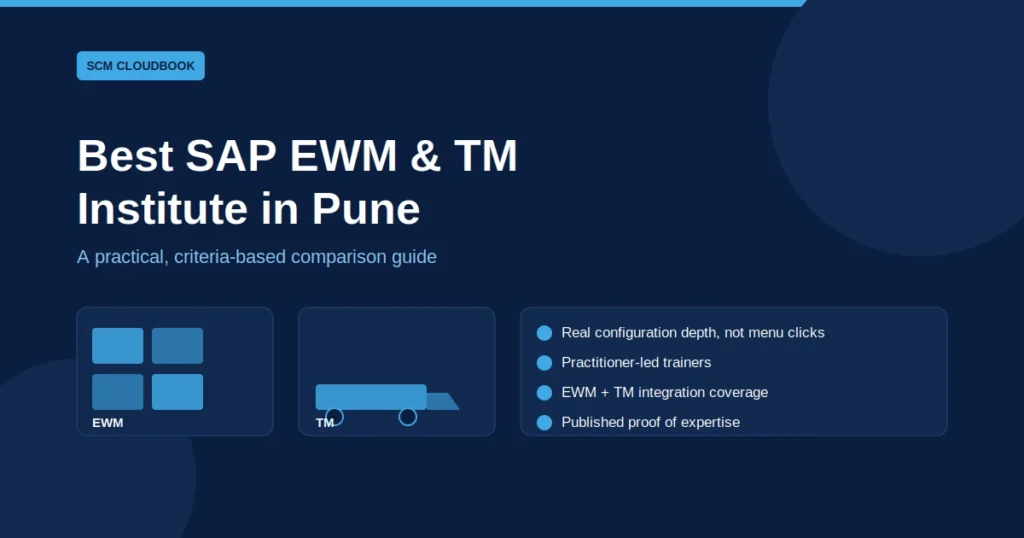
Best SAP EWM, TM and MM (SCM) Institute in Pune: How to Actually Choose One
Search “best SAP EWM, TM and MM institute in Pune” and you’ll land on a dozen listicles ranking institutes by star ratings and phrases like “expert trainers” and “100% placement.” None of it tells you whether an institute can teach what you’ll actually be doing on the job: configuring BRFplus tolerance rules, choosing between ASR and LDAP for EWM-TM integration, tracing a stuck warehouse request through a BAdI, or untangling a Freight Unit that’s stalled mid-lifecycle at 2 AM during go-live.
This is a working framework for evaluating an SAP EWM, TM and MM institute in Pune — built from what actually matters on real projects, not what ranks well in a directory.
Why generic “best SAP institute” rankings don’t help much
Most ranking articles compare institutes on the same shallow markers — years in business, number of modules offered, vague claims about trainer quality. None of that reveals whether the training goes deep enough to matter, or whether the institute specializes in EWM, TM and MM at all, versus spreading thin across ten unrelated modules.
These three modules sit at the intersection of warehouse operations, transportation planning, and procurement logistics — systems that talk to each other constantly on live projects. An institute teaching them in isolation, or teaching everything shallowly, leaves you unprepared for how they actually behave together.
What actually separates a strong institute from an average one
Trainer experience: real project depth, not a certificate and a script
This is the hardest thing to verify from a website, and the most important. A trainer’s value comes from years spent inside live implementations, not from how polished their slide deck is.
When you’re evaluating an institute, push past “our trainers are experienced” and ask specifically how many years of hands-on implementation work the trainer has — not teaching years, project years. Ten-plus is a reasonable floor; fourteen or more is where the depth really shows, because EWM and TM exception handling takes that long to accumulate. A trainer who’s actually lived through a Pick Denial escalation, a duplicate Transportation Unit, or a stuck FSD lifecycle will explain it differently than one reciting from a manual — you’ll hear the difference within five minutes of a demo class.
Curriculum depth: does it go past the basics, or stop there?
A lot of institutes teach the transaction-level flow and call it complete. That leaves a real gap, because the industry doesn’t hire people who can only navigate menus.
Check whether the EWM syllabus reaches into MFS, RF Framework customization, Yard Management, DAS, and Pre-Allocated Stock — not just putaway and picking. On the TM side, does it cover BRFplus-based freight settlement automation, or stop at basic freight order creation? Does MM training connect into real procurement-to-warehouse flows rather than sitting isolated? A course structured in clear basic-to-advanced stages, rather than one flat syllabus, is what actually meets industry hiring expectations.
Real business scenarios, not just transaction codes
Screenshot-driven training and scenario-driven training produce very different graduates. The former teaches you where buttons are. The latter teaches you how to think when something breaks.
Look for institutes teaching end-to-end scenarios — ocean freight processes, warehouse request creation via BAdI against real document types, EWM-TM document flow tracing — and covering the integration points between EWM, TM and MM explicitly, since that’s where most real project problems actually live.
Corporate training as a signal, not just a service listed on the website
Corporate clients don’t buy a module overview. They come with a specific operational problem, often spanning EWM, TM and MM together, and they vet institutes far more rigorously than individual learners do. An institute with a genuine, ongoing corporate training track — not just a mention in the services menu — has already had its depth tested by people with less patience than a first-time student.
Freelancing and independent consulting readiness
This is a question almost no institute addresses directly, which makes it worth asking. SAP EWM and TM are specialized enough that experienced consultants regularly move into freelance work — but only if their training went deep enough to handle client-specific configuration rather than stopping at certification content. Ask whether the institute has any track record of alumni or trainers doing independent EWM/TM consulting, and whether the curriculum was actually built with that outcome in mind.
Whether the curriculum reflects where SAP is actually heading with AI
This is quickly becoming a real differentiator. SAP’s 2026 product direction has pushed EWM and TM from static, rule-based configuration toward AI-assisted and increasingly autonomous operation. Predictive labor demand planning and slotting are now built into EWM, alongside a Real-Time Optimization Agent that continuously re-sequences warehouse tasks as conditions shift. Joule, SAP’s AI assistant, is embedded directly into logistics workflows rather than bolted on as a separate tool. At Sapphire 2026, SAP formally launched Autonomous Supply Chain Management, pairing several Joule assistants with dozens of purpose-built supply chain agents spanning planning, warehousing and logistics execution.
Practically, this means configuration knowledge alone isn’t the finish line anymore. Understanding where AI-driven optimization sits inside EWM and TM — and how a consultant configures, monitors, and troubleshoots around it — is becoming part of what “advanced” knowledge actually means. An institute whose syllabus hasn’t caught up to this is training people for a system that’s already moved on.
Public proof, before you even enroll
The fastest way to evaluate an institute without sitting through a sales call is to read what they’ve already published. Technical blog posts that go into real configuration logic — not generic “what is SAP EWM” explainers — are a good proxy for what the paid course will actually contain. If the public content is thin, the course usually is too.
Where SCM Cloudbook fits against this framework
We built SCM-Cloudbook around SAP EWM, TM and MM specifically, rather than spreading across every SAP module at surface level. A few concrete ways that shows up:
Our training is led by practitioners with 14-plus years of hands-on industry experience, including Nitin Kumar, our Head of Supply Chain Training — not trainers working from a certification manual. The EWM curriculum, including our EWM Super Advanced L3 program, is built in stages from foundational flows through advanced topics like MFS, RF Framework customization, and Yard Management. Our blog reflects exactly what’s taught in the classroom: BRFplus-based freight settlement automation, ASR vs. LDAP for EWM-TM integration, RF Framework customization, and ocean freight E2E process design.
We teach EWM, TM and MM with their integration points covered explicitly, run a corporate training track alongside individual batches, and build configuration depth intended to prepare learners for independent freelance consulting, not just certification. Our curriculum is also updated to reflect where SAP’s AI capabilities sit inside real configuration and troubleshooting work — and we offer a self-paced track for working professionals through our EWM Super Advanced L3 program and SAP TM training.
Rather than take any of this on faith, talk to a trainer directly and ask about a specific scenario — the depth of the answer will tell you more than a rankings page ever could.
Frequently asked questions
What’s the difference between SAP EWM, TM and MM?
SAP EWM (Extended Warehouse Management) handles warehouse-level operations — putaway, picking, packing, RF-based execution. SAP TM (Transportation Management) handles transportation planning, freight booking, and carrier settlement. SAP MM (Materials Management) handles procurement, inventory, and materials logistics. On real projects, all three integrate closely, which is why learning them together reflects how they’re actually used.
How much industry experience should an SAP EWM/TM trainer have?
Look for a minimum of 10-plus years of real implementation experience, ideally 14 or more. Exception handling and integration edge cases in EWM and TM are the kind of knowledge that genuinely takes that long to build.
Can SAP EWM/TM training actually lead to freelance or independent consulting work?
Yes, but only if the training goes deep enough into real configuration logic and exception handling rather than stopping at certification content. Ask any institute directly whether their curriculum was built with that outcome in mind.
How is AI changing SAP EWM and TM, and does that affect what I should learn?
SAP has moved EWM and TM toward AI-assisted and increasingly autonomous operation — predictive labor and slotting, Joule-based decision support, and real-time task optimization agents. Practical EWM/TM knowledge in 2026 increasingly includes understanding how these AI capabilities fit into configuration and daily troubleshooting, not just the traditional rule-based flow.
Does this institute offer corporate training, not just individual batches?
An institute with an active corporate training track record has generally had its depth tested by procurement and technical stakeholders — a harder bar than individual enrollments clear.
How do I verify an institute’s SAP EWM/TM/MM depth before enrolling?
Ask for a sample or demo session, request the detailed basic-to-advanced syllabus, ask directly about trainer years of real implementation experience, and check whether the institute’s public content reflects genuine configuration-level knowledge rather than generic overviews.
Looking to evaluate SAP EWM, TM and MM training in Pune — for a job, corporate upskilling, or freelance consulting readiness? Book an intro call with SCM Cloudbook and ask us any of the questions above directly.
visit: www.cloudbook.co.in
