Complete Guide to ASR vs LDAP Integration in SAP EWM-TM
SAP EWM–TM Integration Using LDAP vs ASR Integration (S/4HANA Guide)
Integration between Extended Warehouse Management (EWM) and Transportation Management (TM) is a critical requirement in modern logistics. With SAP S/4HANA, organizations now have two major integration approaches:
-
ASR – Advanced Shipping & Receiving (New Method)
-
EWM–TM Direct Integration using LDAP / XML Messages (Traditional Method)
This article explains both approaches from a technical configuration perspective, including message flow, trigger points, PPF actions, and monitoring.
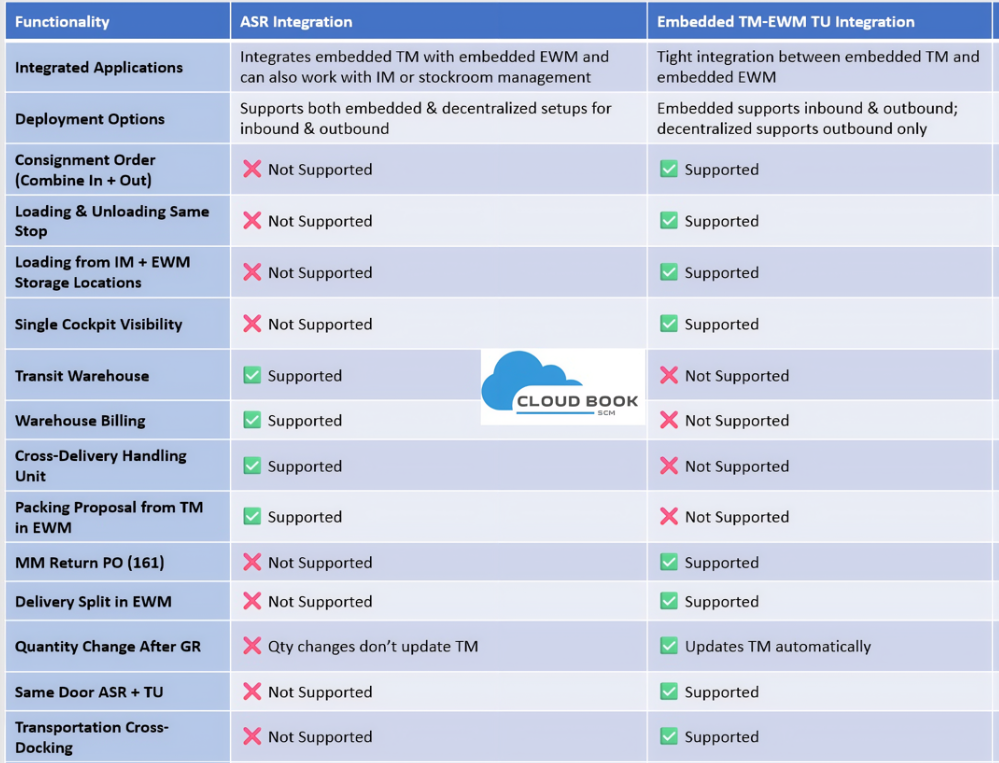
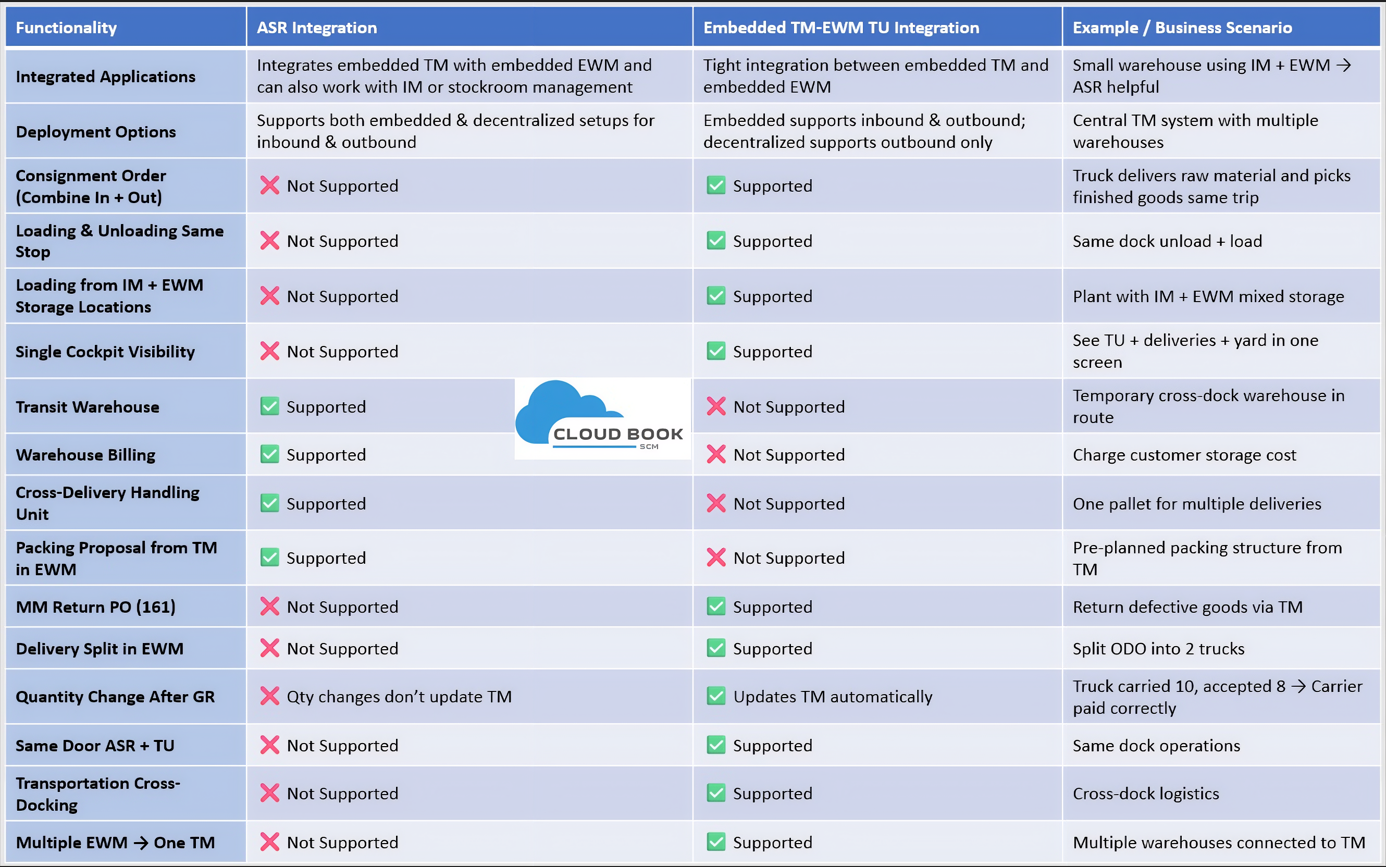
𝐀𝐒𝐑 𝐈𝐧𝐭𝐞𝐠𝐫𝐚𝐭𝐢𝐨𝐧:
•- Best for warehouse service scenarios
•- Supports transit warehouse & billing
•- Limited dock & consignment capabilities
𝐄𝐦𝐛𝐞𝐝𝐝𝐞𝐝 𝐓𝐌-𝐄𝐖𝐌 𝐈𝐧𝐭𝐞𝐠𝐫𝐚𝐭𝐢𝐨𝐧:
•- Real-time transportation execution
•- Supports complex dock operations
•- Full visibility in single cockpit
Traditional Method: EWM–TM Integration Using LDAP Messages
In older architectures, TM and EWM communicate using LDAP-based XML Web Services.
System Landscape
-
Embedded EWM + Embedded TM in S/4HANA
-
Or Embedded EWM + Decentralized TM System
Communication happens via SOAP Web Services (XML messages).
Integration Mechanism
Protocol Used: LDAP (Lightweight Directory Access Protocol) via SOAP XML
Message Type: Web Service XML
Monitoring Tcodes:
-
SRT_MONI
-
SXL_MONITOR
New Method: ASR – Advanced Shipping & Receiving
ASR is the latest integration approach introduced in S/4HANA.
It replaces many LDAP-based processes with tight document synchronization.
Key Benefits of ASR
- Real-time integration Single source of truth
- No duplicate TU creation
- Simplified configuration
- Better yard management integration
LDAP vs ASR – Quick Comparison
| Feature | LDAP Integration | ASR Integration |
|---|---|---|
| Technology | SOAP XML Messages | Native S/4 Integration |
| Real-time Sync | Limited | Full real-time |
| Configuration | Complex | Simplified |
| Data Duplication | Possible | Eliminated |
| Performance | Medium | High |
| Future Scope | Legacy | Recommended by SAP |
When to Use Each Approach
Use LDAP Integration When
-
Legacy TM system exists
-
Decentralized TM is required
-
Older landscape migration in progress
Use ASR When
-
New S/4HANA implementation
-
Greenfield warehouse
-
Need real-time visibility
-
Yard Management integration required
Conclusion
Traditional LDAP-based EWM–TM integration still works in many legacy landscapes, but ASR (Advanced Shipping & Receiving) is the future of SAP logistics integration. It offers better performance, real-time synchronization, and simplified architecture in S/4HANA.
For companies implementing smart warehouse automation, ASR is the recommended path.
At SCM-Cloudbook, we provide real-time project-based training on:
-
SAP EWM MFS
-
SAP TM Integration
-
ASR Configuration
-
Yard Management
-
Warehouse Automation
ASR Architecture and Process Flow in SAP S/4HANA
To understand SAP S/4HANA ASR Integration, helps to take a look at how documents move between TM and EWM. In most cases, the whole thing starts with a Freight Order in SAP TM Integration, which plans how goods should move from one place to another. This Freight Order then gets linked to one or more Freight Units, which are basically the tangible shipping items that actually need to be transported, not just theoretical intent.
After the Freight Order is ready to be executed, SAP creates a Transportation Unit inside SAP EWM. You can see that the Transportation Unit is a “vehicle view” inside the warehouse; it tells EWM what should be loaded, where it comes from, and also by when. At the same time, EWM raises a Warehouse Request, and that one triggers the real warehouse actions, putaway, picking, or loading, depending on the scenario.
The important part of ASR architecture in SAP S/4HANA is the synchronization. Instead of sending separate messages around, back and forth like in older setups, ASR keeps the Freight Order, the Transportation Unit, and the Warehouse Request in sync automatically, in real time. So there’s less manual matching, fewer mismatches or plain mistakes, and the SAP EWM TM process feels smoother from planning all the way to execution, and you can spot what’s happening from a single cockpit.
ASR vs LDAP Integration: Detailed Feature Comparison
The comparison table above gives a quick snapshot, but here’s what those differences really do in practice, like on the ground.
- Data synchronization: LDAP integration in SAP TM leans on XML messages that get passed between systems, which can sometimes lead to delays or odd mismatches, even if everything is “working”. With ASR, documents stay synchronized natively inside S/4HANA, so TM and EWM end up showing the same status all the time, not just mostly.
- Performance: LDAP uses SOAP web services, so there’s extra processing overhead involved. ASR cuts out a bunch of those steps, so document updates feel faster, especially when the warehouse is processing high volumes, and things are moving all at once.
- Yard Management: For yard activities, LDAP integration has pretty limited support. ASR was built with yard management in mind, so gate-in, gate-out, and dock assignment routines run more smoothly, with less friction.
- Transportation execution: With ASR, transportation execution and warehouse execution are kept tightly connected, so planners get better visibility into what is actually going on right there.
- Document consistency: In LDAP-based setups, you can sometimes see duplicate Transportation Units created. ASR prevents that by keeping one single source of truth across TM and EWM, so the same thing isn’t being re-created in multiple places.
Configuration Overview for ASR Integration
Setting up ASR configuration in SAP S/4HANA does not need to be too complicated if you just go step by step, though it can feel messy at first. So, here’s a sort of high-level view of what’s involved, but I’ll keep the technical bits out of it for now
- Business configuration: This part is basically where you turn on ASR at the business level and decide which document categories, like Freight Orders and Freight Units, should use ASR rather than the older LDAP approach
- Integration settings: Then you link the key organizational items, such as warehouse numbers, shipping points, and planning profiles, so that TM and EWM can actually communicate the right way, without gaps.
- Document flow setup: This is where you define the way a Freight Order can automatically trigger a Transportation Unit plus a Warehouse Request, and also make sure the whole thing stays connected like a chain and not separate pieces
- Testing and monitoring: After you finish configuration, you should test end-to-end — from Freight Order creation all the way to the Warehouse Request completion and confirm that the data is flowing correctly at every step. Monitoring tools help verify that the documents are syncing as expected, so problems get caught early, instead of showing up later during real-life work
If you get this right while doing the SAP EWM TM configuration, you lay down a strong base for a stable and near-real-time warehouse process
Real Business Scenarios: When to Choose ASR or LDAP
Picking between ASR and LDAP usually turns into “what kind of project” you’re doing, like, it depends on the whole context, not just the tech.
- Legacy landscape: If the company already has a decentralized TM set up, or some older SAP landscape sitting around , then LDAP integration in SAP TM is often still the practical move. At least, until someone actually plans a full migration, or the roadmap gets real.
- Greenfield implementation: If you’re starting fresh with S/4HANA, ASR feels like the natural fit. There’s no old setup to wrangle, so the team can craft a cleaner, real-time process from day one, without awkward workarounds.
- Warehouse automation project: if the business is putting money into SAP warehouse automation, think automated storage systems or robotics, then ASR is usually the better foundation. The real-time sync, plus a tighter EWM connection, makes it simpler to build on.
- Yard management requirements: When the company wants more control over trucks, dock scheduling, and gate movements, ASR’s improved yard management support tends to be the more reliable option.
In short, ASR lines up with new, forward-looking setups, while LDAP still fits those legacy environments that just aren’t ready to shift yet.
Frequently Asked Questions
1. What is ASR (Advanced Shipping and Receiving) in SAP S/4HANA?
ASR is a newer integration method in S/4HANA that connects Transportation Management and Extended Warehouse Management directly. It helps keep the Freight Orders and Transportation Units kind of synchronized, in real time, so no older XML-based messaging is needed.
2. What is the difference between ASR and LDAP integration in SAP EWM-TM?
LDAP Integration uses SOAP-based XML messages to shuffle data between TM and EWM, which can be slower and kind of a bit more complex to set up, overall. ASR, on the other side, leans on native S/4HANA integration, and then you get real-time synchronization, easier configuration, plus no duplicate Transportation Units.
3. When should you use ASR instead of LDAP integration?
ASR is often recommended for new S/4HANA implementations, and for greenfield warehouse initiatives too; also for any use case where real-time visibility or yard management integration is required.
4. Does ASR replace traditional LDAP-based TM-EWM integration?
ASR is what SAP recommends for the route ahead , but it still doesn’t wipe LDAP fully. A lot of companies that already have older, legacy-type setups keep LDAP integration running for a while, until they feel ready to shift over to ASR.
5. Which monitoring transactions are used for LDAP integration in SAP EWM-TM?
LDAP-based integration is usually monitored with transaction codes SRT_MONI and SXL_MONITOR, so it’s easier to follow XML message flow and then spot errors when things go wrong between TM and EWM.
6. What are the key benefits of ASR integration in SAP S/4HANA?
ASR comes with real-time synchronization sort of instantly, it also gives you easier configuration, no duplicate Transportation Unit creation, better support for yard management, and overall improved performance compared to LDAP.
7. Can ASR and traditional TM-EWM integration coexist in SAP S/4HANA?
Yes, a lot of organizations run both approaches during that awkward transition phase, like using LDAP for legacy processes, and little by little, adopting ASR for new warehouse and transportation scenarios.
Become an SAP EWM & TM Expert! Master warehouse management with our seasoned SAP EWM & TM professionals. Join SCM-Cloudbook’s expert-led sessions and elevate your career in the warehouse industry. Click On
 Registration
 WhatsApp
✆ Call: +91-9289246569, 91-9764427626